|
SP San Jose Depot Trackage: East End Last Addition: 4-30-24 |
||
|
Historical highlight: This page made its debut on Wx4 in December, 2002.
|
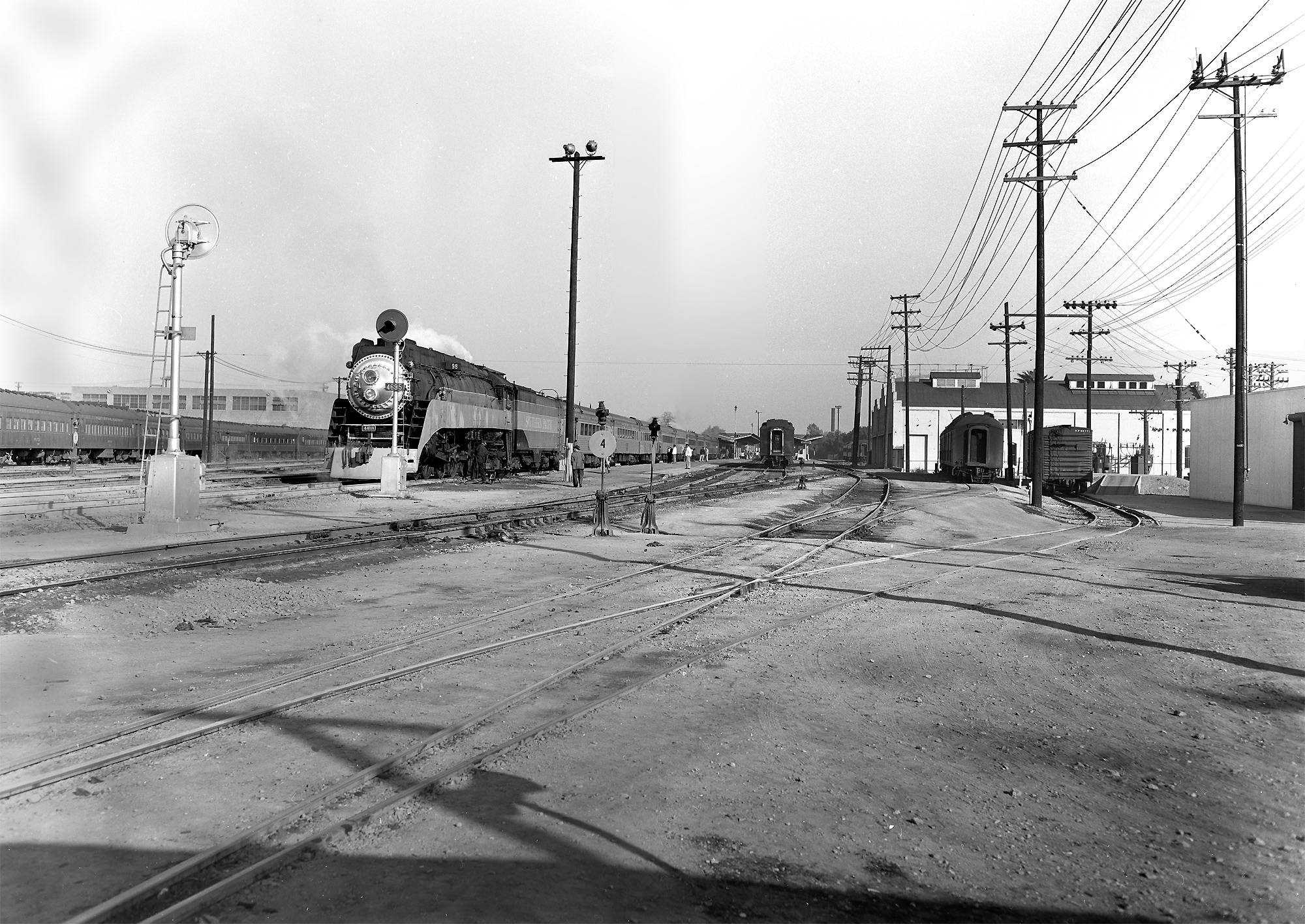
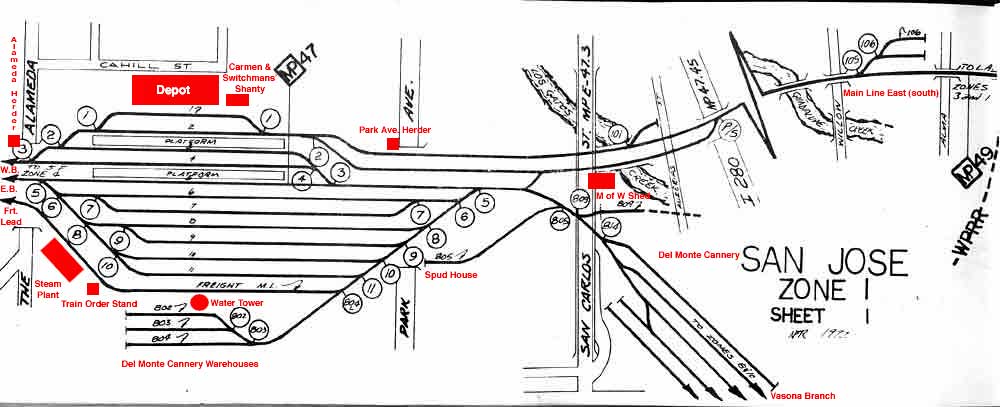
Pre 1971 East End In 1971 the Southern Pacific extensively re-configured its east end trackage when the Park Avenue underpass was widened to four lanes. The photo at left shows the original layout. Click on it to get a detailed graphic for the following discussion. In the photo, the Coast Daylight is heading into Depot 5 from the westbound main. The eastbound main, the adjacent track to the left, merged with the westbound at The Power Switch (shown on the extreme right of the SPINS map below as a circled 'P/S' ), about 1/2 mile south of San Carlos overpass, from which this photo was taken. It was called "The" Power Switch, because it was the only switch controlled by San Jose Telegraph's poor-man's CTC machine. Everything else at the depot was hand throws. The east end switches were lined by the Park Avenue Herder, who is visible "rolling" the train in the shadow next to the dome car. His shanty is to the left of the base of the tall power line tower at upper right. The concrete wall in front of the shanty is the Park Avenue underpass. Just west of the Vasona Branch's signal is a runaround track used primarily for switching the Spud House (left of runaround) and the now long-gone Del Monte cannery warehouse (left of water tower). The Spud House is still there, but as an office building. The warehouse next to it sits atop the present location of the expanded underpass down ramp. The folks at the Spud House had good hearts - tramps regularly showed-up there to have their shopping bags filled with french fries. The place smelled like McDonald's. |
|
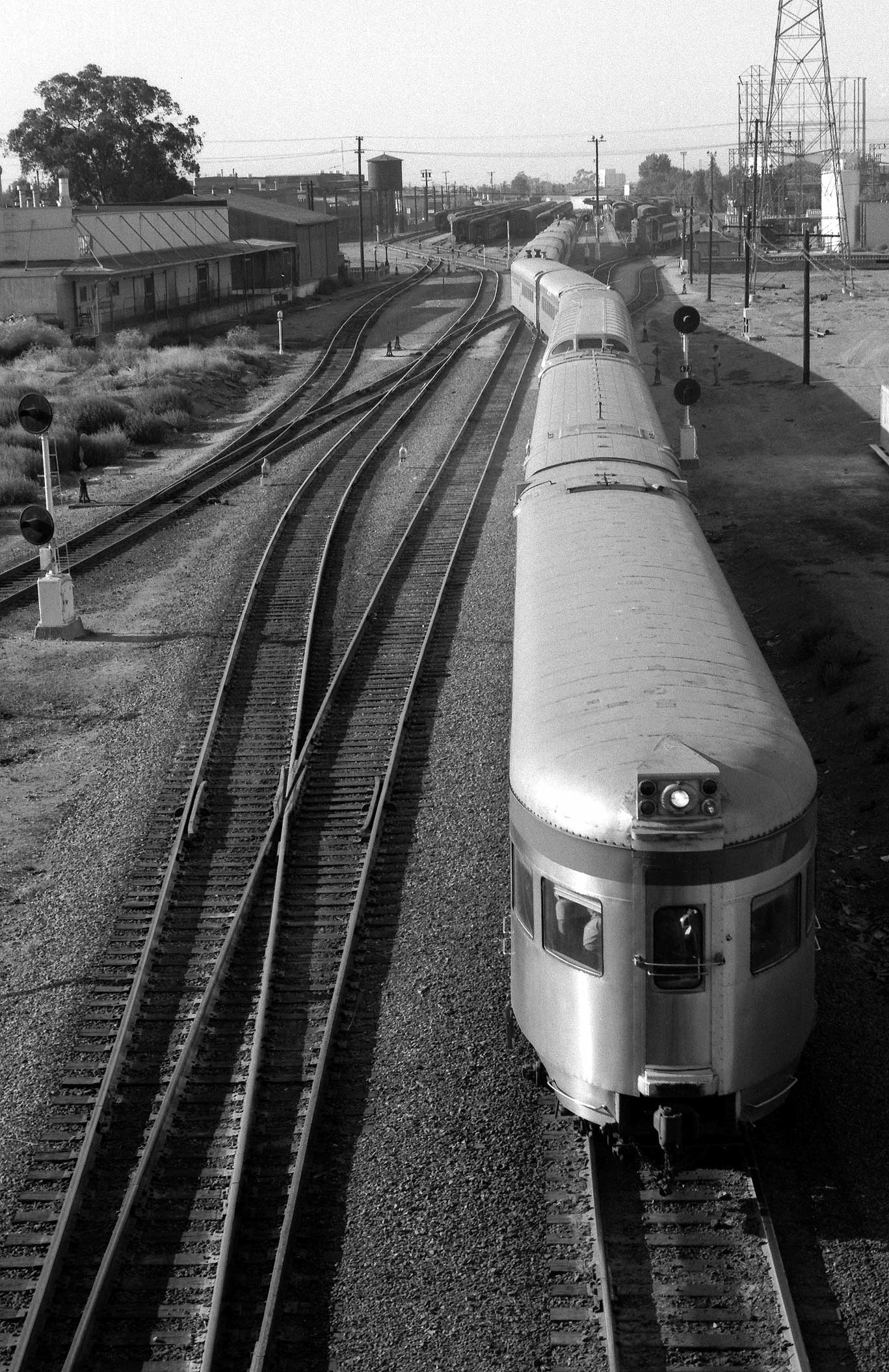
(Above) the westbound Coast Daylight pulls into the depot in June, 1968. That it was summertime is evidenced by the full diner and dome cars. Still, the 12-car train was powered solely by SDP-45 3206 - and on time! (Click on the photo for a Wx4 HumongOfoto®) For a look at the head end with the # 3206 passing Orchard Supply Hardware on the south side of the overpass, see the Daylight Gallery. |
||
 Do you have a current photo of the depot with catenary from San Carlos St. Overpass that you would like to share? wx4org@yahoo.com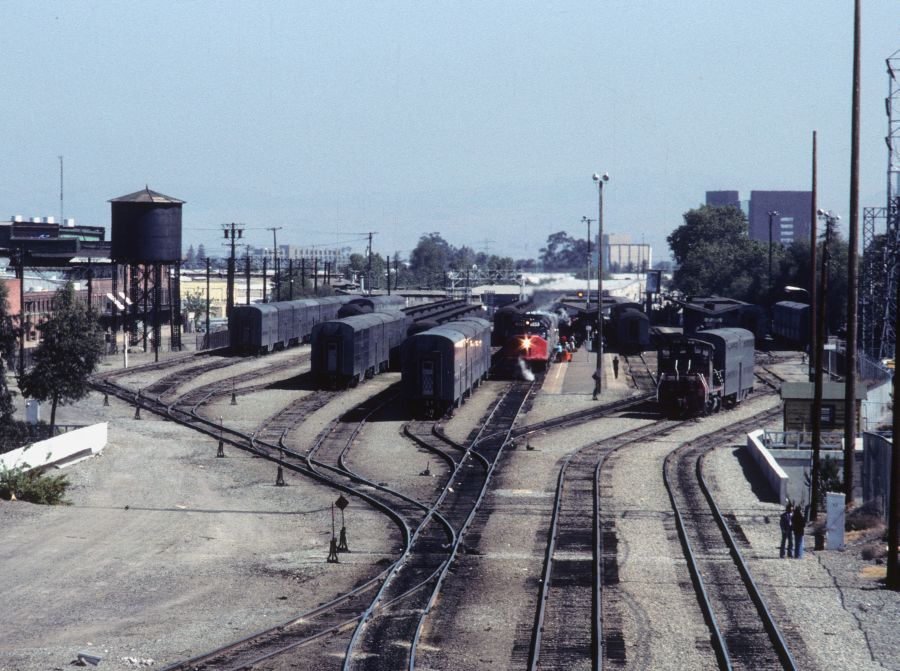

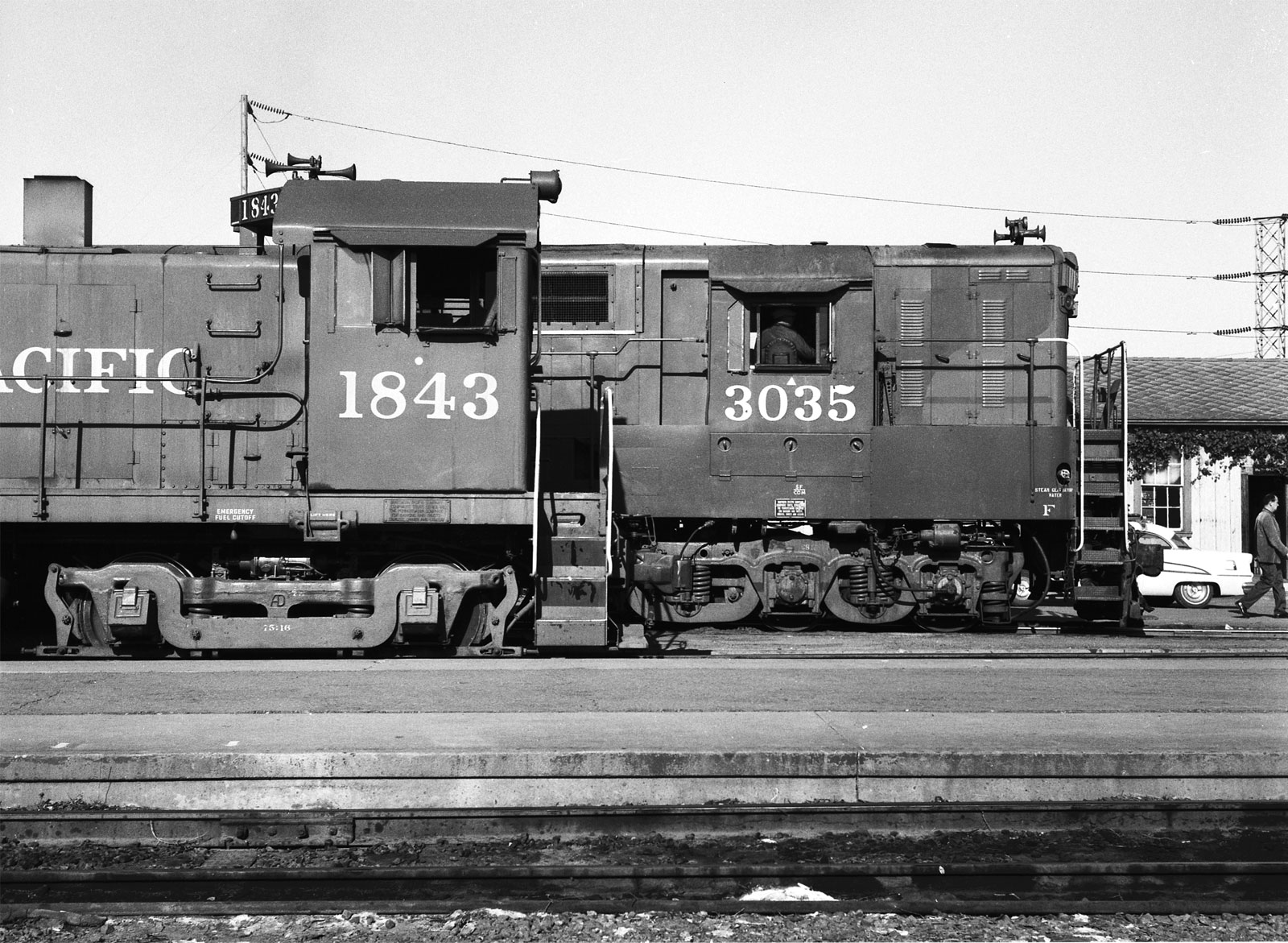
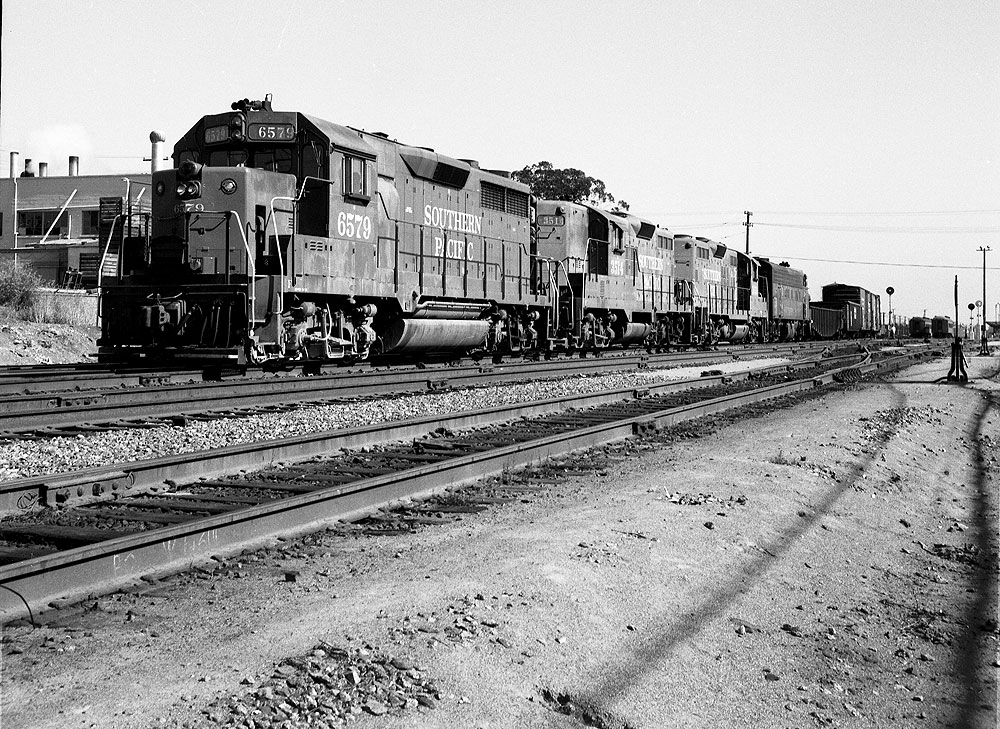
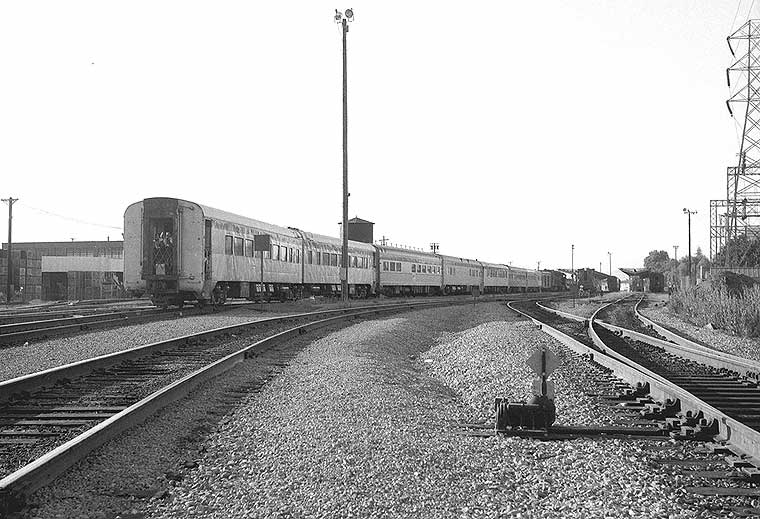
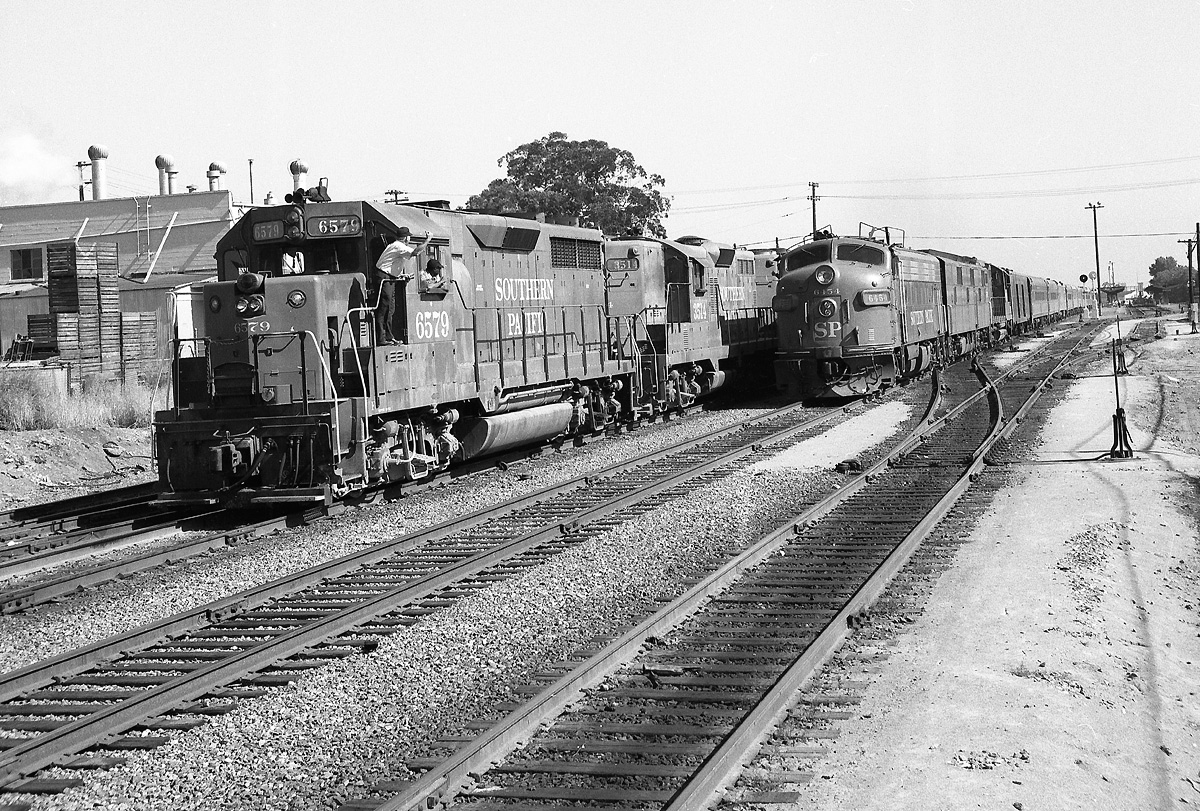
The top two pictures show X6579E, including GP9's 3514 & 3659 and F9 607 cooling its jets at the east end of the Freight Lead next to the Spud House. Of particular interest to Wx4 Staff was the 607, for the ranks of SP F-units were then rapidly dwindling, and as has oft been noted by fans, the remaining ones all seemed to have their own individual personalities. Defining features on the 607 included its roof fans. SP's F9's were rebuilt from Phase 1 F3's and variously did, or did not, keep one, or more of their original "muffin pan" fans. The 607's #2 engine cooling fan was one of those (SP also randomly replaced the original fans on F7's with muffins). Also, unlike most (all?) of the other F9's which had 48" dynamic brake cooling fans, the 607 has a 36" fan, a´ la an F7.
As a bonus, here we've included 1600 pixel HumongOfoto® of the lower X6579 shot, PLUS a like-size screensaver. This photo greatly reminds us of our days on the ground as brakemen, typically spent with a going-away view of the power. To us, black and white photos better convey the grit and grime covering the tracks, equipment and our bib overalls. We can almost smell the creosote, diesel exhaust and, of course, the overwhelming odor of french fries cooking nearby.
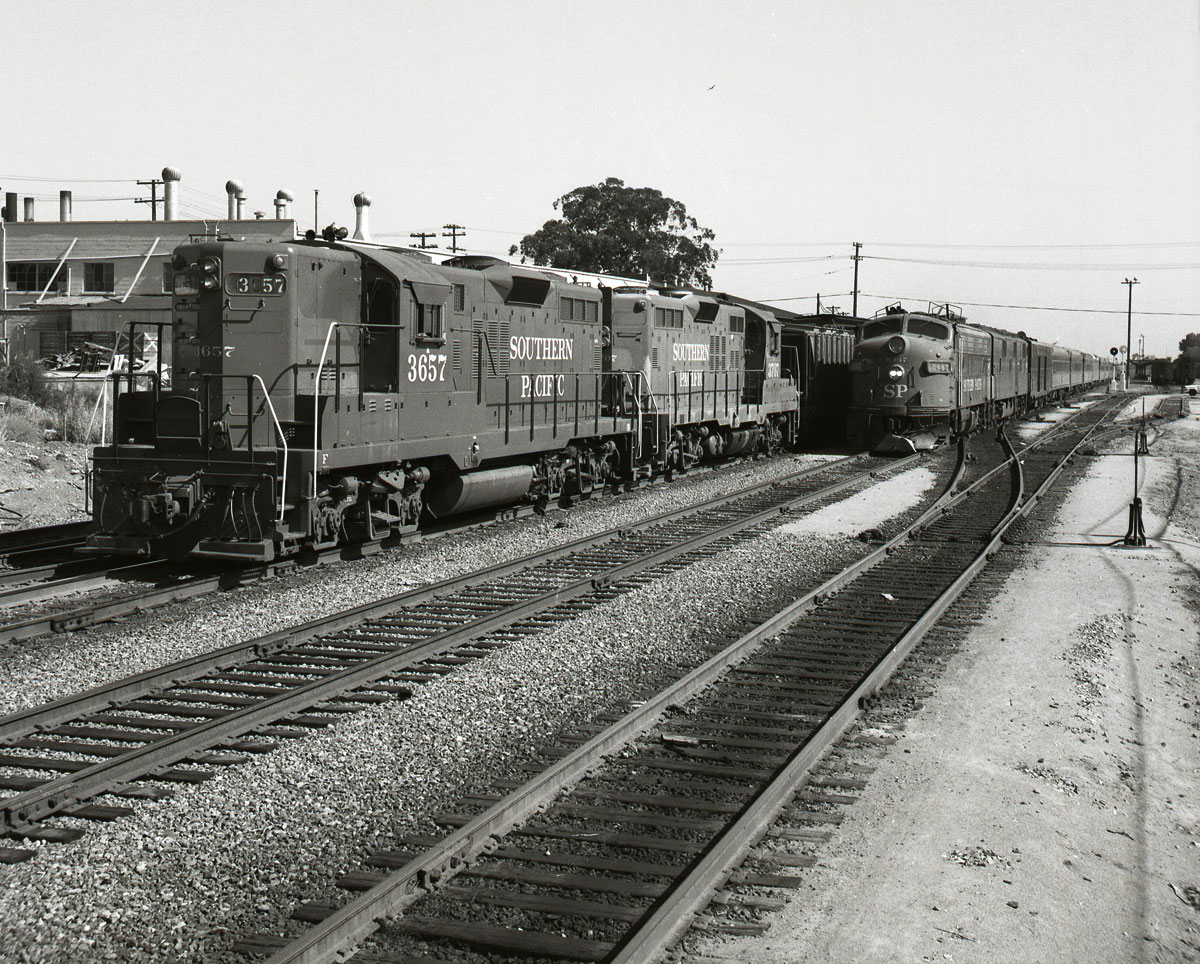
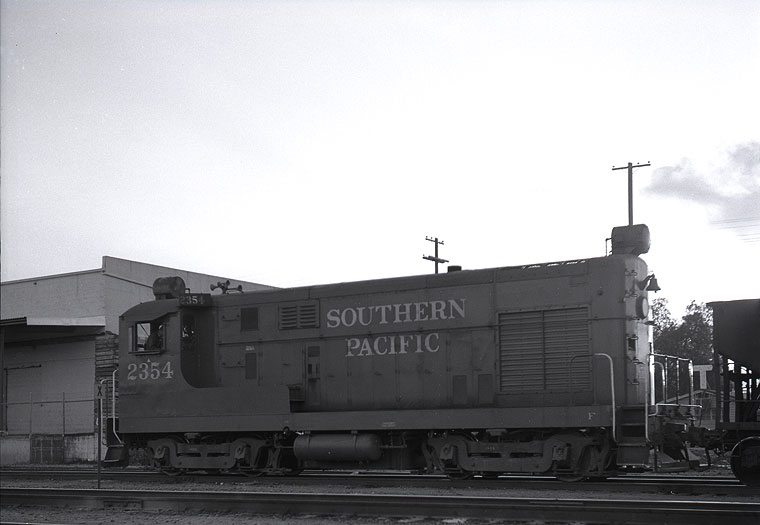
The lower shot show the X3657E, with 3707 trailing, at the identical spot of the above photos. The large drag pulled by ashcan-equipped Fairbanks-Morse H12-44 will stop next to the Orchard Supply Hardware boxcar, short of Auzerais Avenue, and head east towards Luther Junction and the WP interchange at Alma Street (along the old Fourth Street main line) after the Del Monte arrives and the X3657 departs. These drags sometimes ran near 100 cars, and the FM's sometimes required an impromptu boost from the depot goat to make it through the depot's gentle eastbound grade. The H12's also had a finicky governor, which, if not properly maintained, would sometimes cause the engine to load and unload cyclically when performing heavy work. You can experience a pretty accurate simulation of the sound by having a friend take your lawnmower about a hundred feet away and repeatedly cycle it between idle and full speed about every three seconds.
And finally...#98 departs with FP7 6447, E7B 5900 and an Econo-Baggage on the head end.
Another June Day and more waiting: #98 Coast Daylight #98 with #6454, #5916, #3008 passes X6579E (most likely a BSWJY: Bayshore - Watsonville Junction Turn) .
all photos: Wx4


 4-30-24:
Further South: Skirting Willow Glen
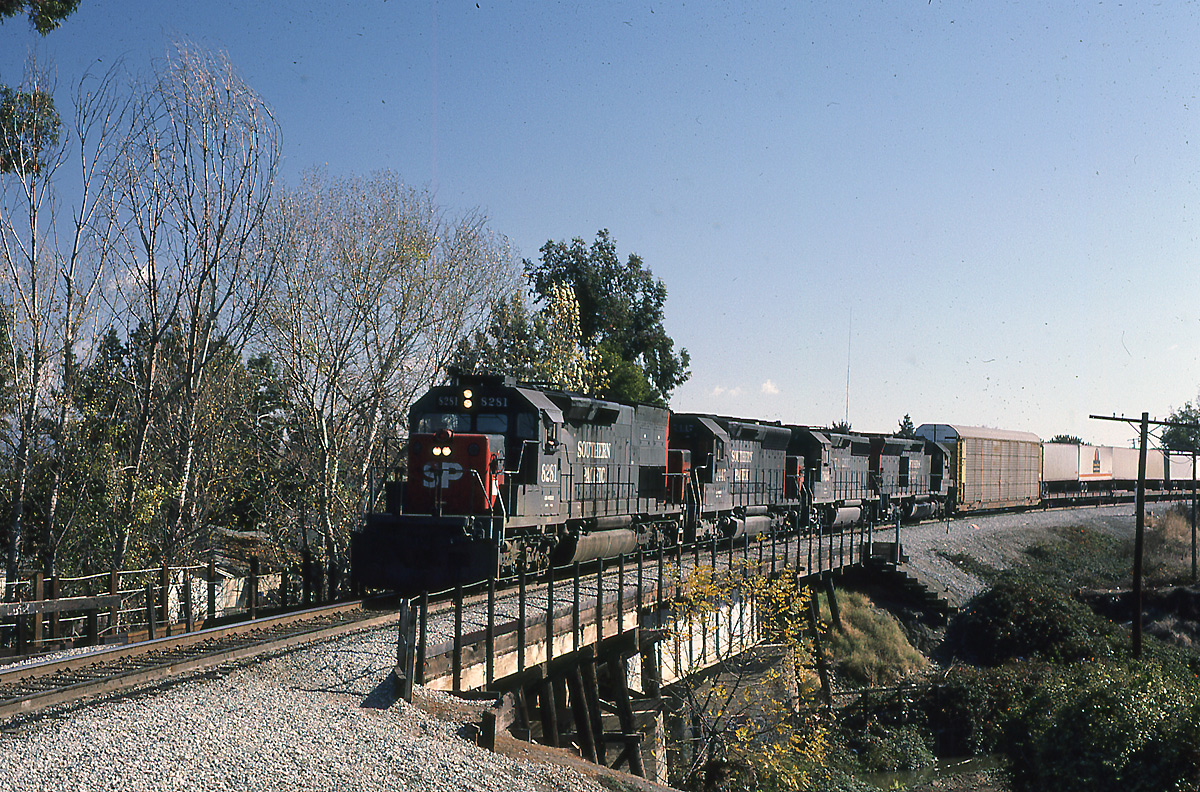
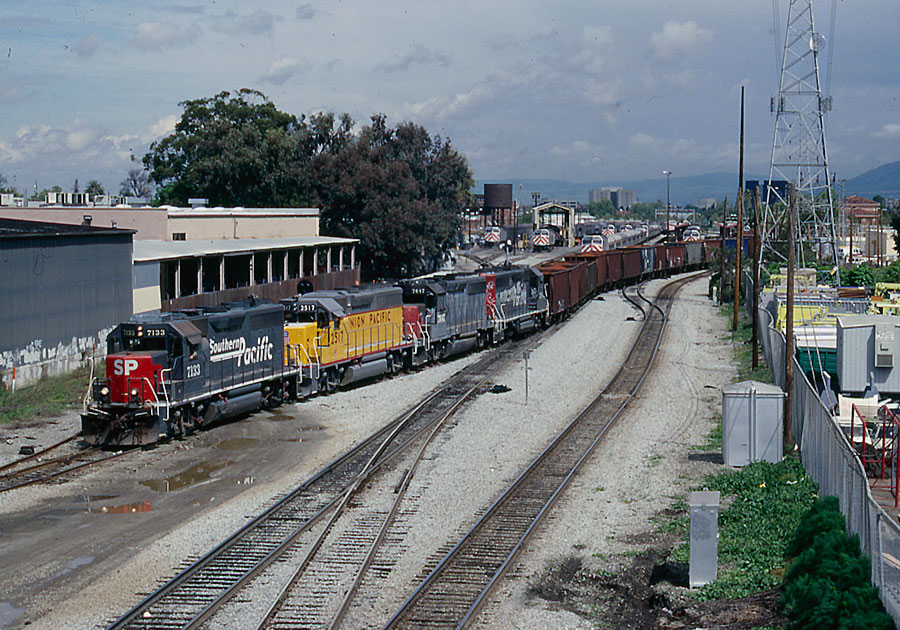
The 1985 scene here was taken as X8281W passes over the Guadalupe River where the tracks resumed their north-south alignment just above today's Tamien Station. Between here and Los Gatos Creek (near San Carlos overpass was once the heart of "The Willows", which remained as a marsh nearly until World War 1. Prior to the war, my father hunted ducks. Today, the head end would be about to enter the limits of CP Delmas on a mmultiple track decorated by catenary. The balance of the power consist is 7447, 7633 and an unknown SD45. - EO
1972 SPINS map: After a false start in 1965, SP finally re-aligned the east end in 1972, in conjunction with the widening of the Park Avenue underpass. Details of both efforts can be found in San Jose's Cahill Street Depot, An Operations Bottleneck & Southern Pacific's Proposed Remedy of 1965 Map items in red, below, were added by Wx4. Our San Jose SPINS Book PDF, available for download here, contains the unaltered original.


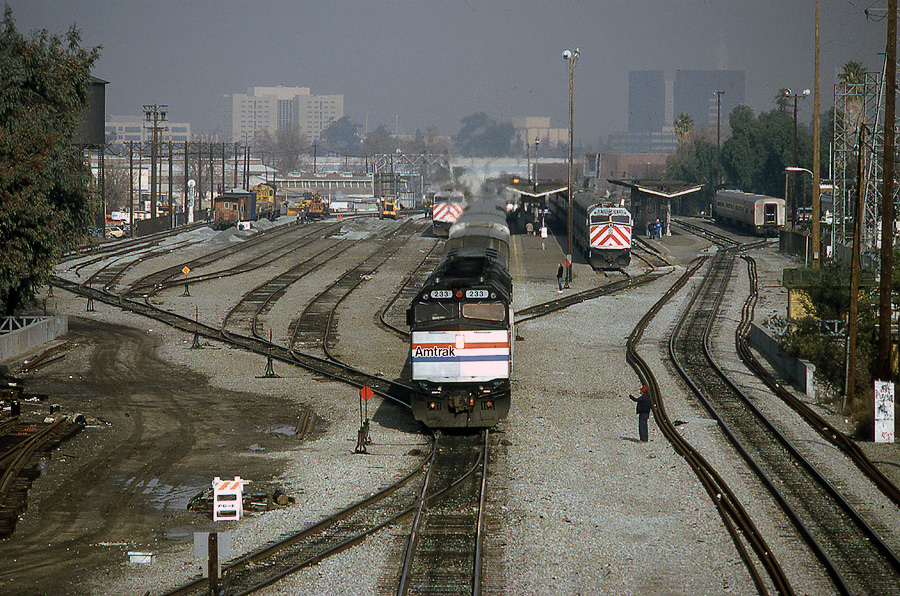
Above:The state turned over its SP-operated Caltrain operation to the involved counties in 1992. Immediately upon its creation the new Caltrain incarnation set about re-arranging things at the depot. The Freight Lead became "San Jose Mechanical's" main servicing track, relegating UP freight trains to track #1. Because SP's 1972 re-alignment eliminated the ability of trains to cross over from track #1 to the Vasona Branch, in the fall of 1992 Caltrain re-installed crossover tracks in the process of preparing for CTC installation.
The above shot by Vic Neves (Wx4 Collection)shoes the state of affairs circa the middle of summer, before the wholesale re-alignments began. There is a lot going on this mid morning. The ribbon rail has aleady been unloaded for Track #1 and the crossover from it to Track #5, where AMK 233 accelerates the Coast Starlight towards points south. Note Herder Marvin Rae giving the fireman a little wave. (He and one of his two conductor brothers transferred from SP to Amtrak at the onset of Caltrain.) On Track #1, a Capitol train waits for departure. Two Caltrain consists are sitting out the morning on Track #4, while on Track #6, the Caltrain F40's marker lights are lit in preparation to double over to a platform track for a westbound departure. Over on Track #11, a work train is busily dumping ballast in the future servicing area.
You may have noticed the position of the switch target by which #233 is passing. Nope, the switch is not "wrong"; the loco is not running through the switch. The "normal" switch position was for the Freight Lead (the ladder track) which guided freight movements around the depot. Even though Track #5 was designated at the main track for some reaon, passenger trains (freights were banned from #2-#5, remember) had to be lined in and out by the herder. Marvin will now walk to the crew lounge inside the depot, where the coffee pot was located. (The yellow herder shany at far right was by now a homeless persons' restroom, even though it was sans toilet) He will not have awfully much more to do before the end of his shift at 2:00 pm. High seniority had its advantages.
Below: In this photo recorded by Charles Lamphere in 2000, we see the Permanente ("Perm") crossing over the new arrangement. In the mid-90's Caltrain finally gave the rounhouse personel a break by constructed the engine hose - complete with pit and overhead crane - that we see just to the right of the old water tank.* From then until 2007, when Caltrain opened its CEMOF facility across the tracks from the old SP roundhouse site, the "house" performed the great majority of locomotive repairs, save the turning of flattened wheels (an ongoing issue), which was done by SP at Sacramento, and later UP at Roseville, I believe. The coaches were serviced here, but save running repairs, mechanical work was performed on them in San Francisco until CEMOF consolidated things. For a short time after CEMOF opened, the old roundhouse area reverted to storage tracks, bur these eventualy became arrival-departure tracks. Part of the impetus for CEMOF came from the fact that San Jose Mechanical's office and support buildings were sqautting on county-owned land slated to become a light rail station. (Charles Lamphere slide, Wx4 Collection)
* ...which went dry after Caltrain retired its ex SP steam heated equipment in 1985. Not long before this photo, the tank's wooden roof collapsed, with some of the falling debris narrowly missing Boris, the machinist.