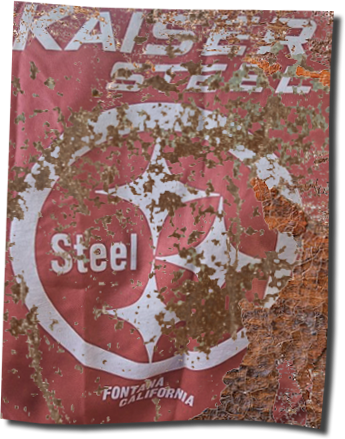
In recent decades the Eagle Mountain Railroad became best known as a playground for homemade speeders and railcarts, Youtube is full of their videos. However, long before that the line was a major ore hauler. As per Wikipedia and several other sources, Henry J. Kaiser got his start in heavy industry in the construction trades, mostly in large construction contracts- he was one of the "Six Companies" that built Hoover Dam- before getting into ship building at the dawn of the 1940s. The lack of any steel plants on the west coast forced Kaiser to purchase all the steel used to build ships from eastern steel mills. That supply chain became extremely problematic after the start of Wold War II as fighting and winning the war created a nearly insatiable demand for new ships, but getting steel shipped west to Kaiser's shipyards proved ever more problematic in the face of the wartime traffic rush. Kaiser had already been working towards building a steel mill in the west, which
accelerated after the Japanese attack on Pearl Harbor. The Federal Government provided financing to build the mill but stipulated it had to be at least 50 miles from the coastline, publicly to protect it from potential Japanese raids, though many privately suspected eastern steel mills lobbied for the restriction so as to render the plant less competitive in a post-war economic environment. Kaiser selected a site in Fontana, which lay five miles outside the 50-mile inset from the coast requirement. Kaiser broke ground on the new mill in April 1942, and the plant produced its first steel plates in August 1943.
Kaiser initially sourced iron ore mostly from the small Vulcan Mine near Kelso, California, while he searched for larger and better quality deposits. By 1945 Kaiser had zeroed in on the Iron Chief Mine, which had up to that point produced around $250k in gold; however, Kaiser
was far more interested in the iron ore deposits that had been a major obstacle to gold recovery. Southern Pacific owned the mine claims which they sold to Kaiser for $1 million. Kaiser determined rail was the only feasible way to ship the ore the 160 miles between the mine and mill, and to that end between 1946 and 1947 Kaiser built what became known as the Eagle Mountain Railroad, running 51 miles from a connection with the Southern Pacific at Ferrum on the eastern shore of the Salton Sea to the Eagle Mountain mine. The railroad was one of the largest entirely private railroad projects built, it ended up costing the company a little shy of $4 million to construct. Kaiser built a fully functional company town adjacent to the mine for their employees. The mine shipped its first ore in August 1948.
Kaiser turned to Baldwin for locomotives to power the new railroad, starting with DRS-6-6-1500s 1010A and 1010B in 1949, followed by AS-616s 1012A and 1012B in 1952. Sometime around 1958 Kaiser acquired a third former Chesapeake & Ohio AS-616 that they numbered
1029, about the same time they renumbered the original quartet 1025-1028.
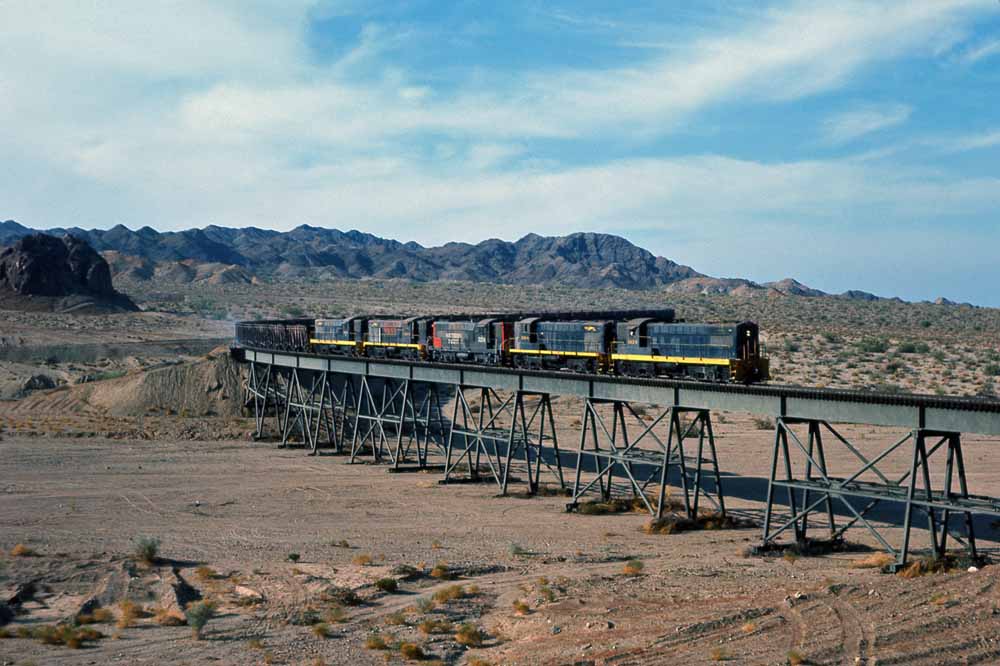
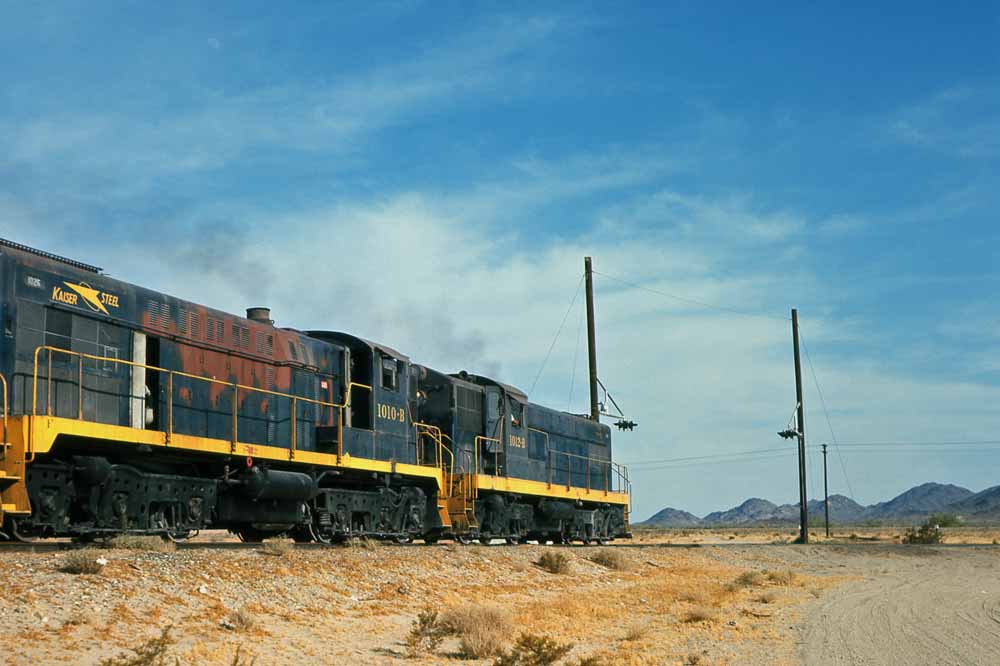
Charles visited the Eagle Mountain at least twice and maybe three times. During his first one or two visits he found the Baldwins still active, though looking tired and still carrying their original numbers. We'll start with a map of the railroad and then two of his Baldwin shots, first of four Kaiser Baldwins spliced by leased Southern Pacific AS-616 #5254 crossing the large steel bridge that carried the railroad over a normally dry wash, and then a going away shot of the 1012B and 1010B approaching a grade crossing.
|
NEW 12-21-25:
Eagle Mountain Railroad and a Bit of SoCal Southern Pacific
Commentary by Jeff Moore
Charles Heimerdinger Photos - Jeff Moore Collection
|
|
|
|
Next we have three more Baldwin shots, starting with a nice broadside view of the 1012B framed in front of a developing hunderhead in the background. The other two shots are either of different train that same day or of a different day as two more leased SP Baldwins have joined the #5254 in the consist.
|
|
|
|
|
|
|
|
|
Here we have three shots of six big Baldwin diesels with a train returning to the mine. Of interest in this train is the 40' boxcar and the ADM covered hoppers, anyone have a clue what they might have been doing on the railroad? The few sources I have on the railroad really only mention the outbound ore traffic, so I don't have a good explanation as to what these are doing on the railroad.
|
|
|
|
|
|
|
|
In 1968 Kaiser ordered five new U30Cs from General Electric to replace the Baldwins, which they either sold or moved to their other operations. GE built the locomotives concurrent with SP's first order of U30Cs, and except for lacking red signal lights they were nearly
identical to the SP models, though Kaiser ballasted their five to a weight of 216 tons, making them among the heaviest six axle power in operation almost anywhere. Charles only got a few shots of the big GEs sometime shortly after their arrival, all on a return trip to the mine. I do remember reading in one of the magazine articles published about this railroad that Kaiser experienced problems with the batteries overheating on the big GEs, which they solved after a little while by painting the battery compartment doors white; obviously Charles shot these before they had made that change.
|
|
|
|
|
|
|
|
We'll wrap up Charles's work on the Eagle Mountain with three last shots, two more of the big GEs lugging empty ore cars up the grade towards the mine, and then one shot of one of the railroad's two homebuilt cabooses bringing up the rear of a train. The caboose is still wearing the red, orange, and white stripe paint scheme originally applied to the Baldwins before they got repainted into the blue and yellow.
|
|
|
|
|
|
|
|
|
|
|
Kaiser handed the 100-car ore trains off to Southern Pacific at Ferrum for the balance of the journey to Fontana. Part of this movement included 47 miles of adverse 1.99% grade between Indio and Beaumont, which resulted in some impressive power lashups. In these first two photos we see a Kaiser ore train passing through Palm Springs with six units (U25B, four F-units, and a Geep or SD) on the point and then eight Geeps cut in as mid-train helpers. One last shot shows SP's enginehouse at Indio in 1958. |
|
| Our concluding photos begin with an action shot at Indio of SP #624 passing #6314 and then two shots of #359 leading an almost all F-unit consist, first at Redlands and then in San Timoteo Canyon. |
|
|
|
|
|
|